
12 bet types · all free
The free bet calculator for every UK bet type and each way returns
Work out exactly what a bet returns before you place it or after it settles. This free bet calculator covers every standard British bet type, from a single up to a 247-line Goliath, and handles the details that trip people up — each way terms, non-runners, Rule 4 deductions and dead heats.
Every free bet calculator, ordered by size
The number of bets is what determines your stake. A £1 bet on any of these costs £1 for every line it contains, so the same unit stake produces wildly different outlays. Each one below is a complete free bet calculator in its own right, with a worked example and the settlement rules explained.
- Accumulator calculator 4 selections 1bet
- Trixie calculator 3 selections 4bets
- Patent calculator 3 selections 7bets
- Union Jack calculator 9 selections 8bets
- Yankee calculator 4 selections 11bets
- Lucky 15 calculator 4 selections 15bets
- Canadian calculator 5 selections 26bets
- Lucky 31 calculator 5 selections 31bets
- Heinz calculator 6 selections 57bets
- Lucky 63 calculator 6 selections 63bets
- Super Heinz calculator 7 selections 120bets
- Goliath calculator 8 selections 247bets
Choosing between a bet calculator with singles and one without
British multiples come in two families and the distinction is worth getting right, because it decides whether one winner pays you anything. The full cover bets — Trixie, Yankee, Canadian, Heinz, Super Heinz and Goliath — contain every combination of your selections except the singles. Two winners is the minimum for any return.
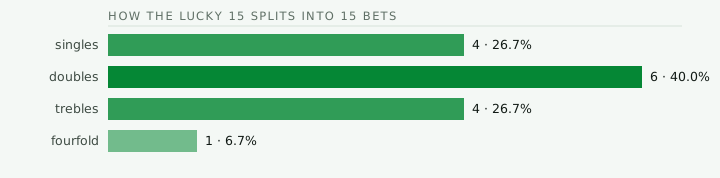
The lucky family — Patent, Lucky 15, Lucky 31 and Lucky 63 — adds those singles back in. One winner returns money, and these are the bets that usually carry bookmaker bonuses. You pay for the difference in stake: a Yankee is 11 units, the Lucky 15 covering the same four selections is 15.
There is no universally correct answer. Short-priced selections favour the singles, because they are the lines most likely to land. Bigger prices favour the multiples, because that is where the compounding happens. The only way to know which applies to your actual bet is to run both through a calculator with your real odds and compare the returns side by side.
| Selections | Without singles | With singles |
|---|---|---|
| 3 | Trixie (4) | Patent (7) |
| 4 | Yankee (11) | Lucky 15 (15) |
| 5 | Canadian (26) | Lucky 31 (31) |
| 6 | Heinz (57) | Lucky 63 (63) |
| 7 | Super Heinz (120) | — |
| 8 | Goliath (247) | — |
Using the each way bet calculator on a multiple
Switching any of these to each way doubles the number of lines, because every bet is settled twice — once on the win terms and once on the place terms. A £1 each way Lucky 15 is 30 bets and costs £30, not £15, which is the single most common surprise on a betting slip.
The each way bet calculator asks you for the place fraction rather than assuming one, because the terms belong to the race and not to the bet type. A big handicap paying a quarter of the odds and an ordinary race paying a fifth produce noticeably different returns from identical selections, and on long-priced runners that difference is where most of the value sits. The dedicated each way bet calculator handles a single selection if you want to see the two halves separated out.
What the calculator does with the awkward cases of UK racing
Most calculators handle four winners at fixed prices. The situations that actually cost people money are the ones where something unusual happened to the race, and those are built into every UK bet calculator on this site.
Non-runners settle at odds of 1.00 rather than losing, so your fourfold quietly becomes a treble. Rule 4 deductions take a fixed number of pence in the pound out of your winnings when a horse is withdrawn late, scaled to how well backed that horse was. Dead heats reduce the stake on the affected selection in proportion to how many runners shared the position, settling the remainder as a loser.
Each of those is set per selection rather than for the whole bet, because in practice they usually affect one leg of a multiple and not the others. The Rule 4 calculator and the dead heat calculator deal with each one in isolation if you want to see the effect on its own.
How the maths behind every bet calculator works
Every bet on this page is built from the same operation, repeated: multiply the decimal odds of the selections in a line together, then multiply by the unit stake. What separates a Trixie from a Goliath is not the arithmetic but how many lines the bet contains, and that count follows a rule you can work out yourself.
For the lucky family — Patent, Lucky 15, Lucky 31, Lucky 63 — the number of bets is two to the power of the number of selections, minus one. Three selections give seven bets, four give fifteen, five give thirty-one, six give sixty-three. Every doubling of coverage roughly doubles the cost, which is why a Lucky 63 is a far larger commitment than the name suggests.
For the full cover bets — Trixie, Yankee, Canadian, Heinz, Super Heinz, Goliath — you take the same figure and subtract the singles. Four selections give fifteen minus four, which is the eleven lines of a Yankee. Six give sixty-three minus six, which is the fifty-seven of a Heinz and the reason for its name.
The calculators derive those counts rather than storing them, which means a wrong number would be a wrong formula rather than a typo. It is also why the structure table on each page and the worked example beneath it can never disagree with the tool above them: all three come from the same code.
Choosing a stake before you choose a bet type
The most common mistake with multiples is picking the bet first and discovering the stake afterwards. A £2 Lucky 31 sounds modest and costs £62. A £1 Goliath sounds trivial and costs £247. Because the unit multiplies by the line count, small changes to the unit have large effects on the total.
The reliable way round it is to decide the total you are prepared to risk, then divide by the number of lines to get the unit. Twenty pounds across a Heinz is a 35p unit; the same twenty across a Lucky 15 is £1.33. Working in that direction also makes the comparison between bet types honest, because you are holding the money constant instead of the unit.
It changes which bet looks attractive, too. At a fixed total stake, a smaller bet type puts more money behind each line, so it pays more when it lands. A larger bet type spreads the same money thinner in exchange for more ways to win something. Neither is universally better, and the bankroll management guide covers how to size the total in the first place.
The settlement cases that change what you get paid
Four situations account for nearly every occasion when a return differs from what the slip suggested, and every calculator here handles all four per selection rather than for the bet as a whole — which matters, because on a multiple an adjustment to one leg flows through every line that leg appears in.
Non-runners. A withdrawn selection settles at odds of 1.00 rather than losing, so the bet reduces around it. A fourfold becomes a treble, trebles become doubles, and the single is returned. One withdrawal turns a Goliath into a Super Heinz.
Rule 4. When a horse comes out too late to reprice the market, a fixed deduction in pence in the pound comes off winnings — never off your stake. The size depends on how well backed the withdrawn horse was, not on your own price, which is the part that surprises people.
Dead heats. Your stake is divided by the number of runners sharing the position, that portion is paid at full odds, and the rest is settled as a loser. This is not the same as being paid half the odds, and the gap widens as the price lengthens.
Each way. Not an adjustment so much as a second bet, but the one most often misread: it doubles the stake, and a winning selection collects on both halves rather than just the win part.
Bet calculator questions
How does a bet calculator work out returns?
It converts every price to decimal odds, builds each line the bet contains, and multiplies the odds of the selections in that line by your unit stake. A Lucky 15 has 15 lines, so the calculator settles 15 separate bets and adds the results together.
Which bet calculator do I need?
Count your selections and decide whether you want singles included. Three selections without singles is a Trixie and with singles a Patent; four without singles is a Yankee and with singles a Lucky 15. The full list on this page is ordered by how many bets each one contains.
Do these calculators handle each way bets?
Yes. Switching to each way doubles the number of bets, because every line is settled twice — once on the win terms and once on the place terms. You choose the place fraction, which is set by the race rather than by the bet type.
How are non-runners handled in a bet calculator?
A withdrawn selection is settled at odds of 1.00, so it neither wins nor loses and every line containing it simply drops a leg. Marking a selection as void reproduces exactly what the bookmaker will do at settlement.
Can I work out a free bet return with these calculators?
Most free bets are stake-not-returned, meaning you keep the profit but not the stake. Work out the return normally, then subtract the stake of the free bet portion to get what actually lands in your account.
Are the calculations on this site rounded?
Returns are shown to two decimal places, but the underlying calculation is done at full precision and only rounded for display. Bookmakers round individual line settlements in slightly different ways, so a penny of difference on a large multiple is normal.
Do I need an account to use these tools?
No. Every calculator on this site runs entirely in your browser. Nothing you type is sent anywhere, and there is no sign-up of any kind.
What is the difference between a full cover bet and an accumulator?
An accumulator is one line combining every selection, so a single loser ends the bet. A full cover bet contains every combination of your selections, so partial success still pays. The trade-off is cost: a fourfold is one unit, a Yankee on the same four selections is eleven.