
Bankroll management for betting: stake sizing for a losing run
Bankroll management is the part of betting that decides whether an edge ever gets the chance to show. Most people who lose money betting do not lose it because they picked badly — they lose it because they staked badly.
Start with a bankroll that is genuinely separate
A bankroll is a fixed sum set aside for betting that you would be able to lose entirely without it affecting anything else in your life. That definition does the most important work in this whole guide, because everything downstream — unit size, staking plan, how you respond to a losing run — depends on the money being genuinely expendable.
The practical test is whether a total loss would change any decision you make about rent, bills, savings or anyone who depends on you. If it would, the figure is too large, and no staking system compensates for that. Topping the bankroll up from general funds after a bad run is the single most common way a recreational habit becomes a serious problem.
Keeping it in a separate account makes the boundary real rather than notional. It also gives you an honest running total, which is harder to avoid looking at than a vague sense of being roughly level.
Unit size: why 1% to 2% is the usual answer
A unit is your standard stake, expressed as a percentage of the bankroll. Most staking advice lands between 1% and 2%, and the reason is arithmetic rather than convention: it is the range where a normal losing run is survivable without the bankroll being crippled.
Losing runs are longer than intuition suggests. Betting at even money with a genuine edge, a run of eight consecutive losses will happen to almost everyone eventually; ten is not rare. At 2% units, ten straight losses costs 20% of the bankroll — unpleasant but recoverable. At 10% units the same run costs almost two thirds of it, and the remaining stake is now so small that recovering requires a far better strike rate than you had before.
This asymmetry is the core of the whole subject. Losses compound against you in a way that gains do not compound for you: losing 50% requires a 100% gain to get back to level. Keeping the unit small is what stops that arithmetic from ever getting started.
Flat, percentage and Kelly staking compared
Flat staking bets the same amount every time, calculated from the starting bankroll. It is simple, it is easy to be disciplined about, and it makes your results easy to interpret because every bet counted equally. Its weakness is that it does not adapt: after losing half the bankroll, a flat unit is now twice as large a proportion of what remains.
Percentage staking recalculates the unit from the current bankroll before every bet. Stakes shrink automatically during a bad run and grow during a good one, which mathematically means the bankroll can never quite reach zero. The cost is slower recovery, since you are staking less exactly when you are behind.
The Kelly criterion goes further and scales the stake to the size of your edge on each individual bet, staking more when the value is greater. It maximises long-run growth in theory, but it requires a probability estimate for every bet and is punishing when those estimates are optimistic. Most people who use it stake a half or a quarter of what it recommends.
Running all three through the bankroll simulator at the same edge is more persuasive than any argument here. The differences in risk of ruin are large and immediately visible.
Why progression systems do not work
Martingale — doubling after every loss so that one win recovers everything — is the most seductive idea in betting and one of the most reliably ruinous. It produces a long series of small wins followed by one loss that takes everything, and the maths guarantees that the loss arrives eventually.
Two things kill it. Stakes grow geometrically, so a run of ten losses requires a stake over a thousand times the original, and bankrolls are finite. Bookmakers also impose maximum stakes, which caps the recovery long before your own money runs out. The system needs infinite funds and infinite limits, and neither exists.
Every progression system that increases stakes after losses shares this shape in some form. They redistribute when losses arrive rather than reducing them, converting frequent small losses into rare enormous ones. Nothing about the sequence of previous results changes the probability of the next one.
Judging results over a sample that means something
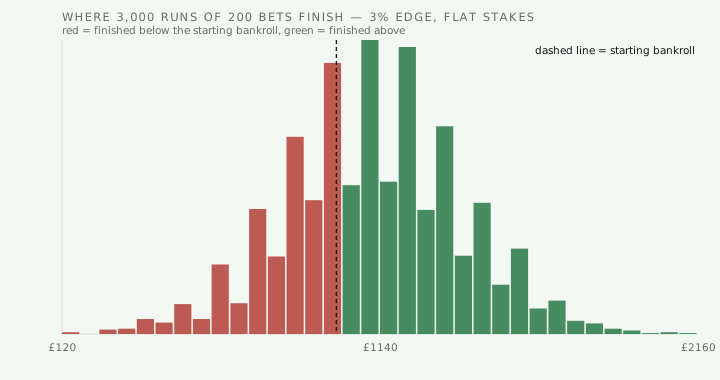
Fifty bets tell you almost nothing. Even a strong edge is comfortably hidden by variance over that distance, and so is a losing strategy — which is why both winning and losing runs feel far more meaningful at the time than they are.
Tracking closing line value gives you a faster signal. If you consistently take prices longer than the price the same bet settles at when the market closes, you are beating the market, and that shows up over a much smaller sample than profit does. It is the difference between measuring your judgement and measuring your luck.
Whatever you track, write it down as you go. Memory is systematically kind about betting results, and a record kept honestly is the only defence against gradually revising your own history.
Questions
How big should a betting bankroll be?
Whatever you could lose entirely without it affecting any other financial decision. There is no correct absolute figure — the test is about expendability, not size.
What percentage of my bankroll should I bet?
Between 1% and 2% per bet is the usual range. It is small enough that a normal run of eight to ten losses is survivable, and large enough that a genuine edge produces meaningful growth.
Is flat staking or percentage staking better?
Percentage staking reduces the risk of ruin because stakes shrink automatically during a losing run. Flat staking is simpler and makes results easier to interpret. Both are far better than any system that increases stakes after losses.
How long can a losing run last?
Longer than most people expect. At even money with a genuine edge, eight consecutive losses will happen to almost everyone eventually and ten is not unusual. Unit sizing exists to make those runs survivable.
Does the martingale system work?
No. It converts frequent small wins into rare catastrophic losses, and it requires both an infinite bankroll and no maximum stake. Bookmaker limits alone are enough to break it.
How many bets before I know if my strategy works?
Profit is a slow signal — several hundred bets at minimum, often more. Tracking closing line value gives you a usable read far sooner, because it measures whether you beat the market rather than whether you got lucky.