
15 bets · 4 selections
Lucky 15 calculator: work out your returns, each way and bonus
This Lucky 15 bet calculator settles four selections across all 15 lines. One winner is enough to get something back, which is what separates a Lucky 15 from a Yankee and why it is the most popular multiple bet in British betting shops.
How the 15 bets in a Lucky 15 are made up
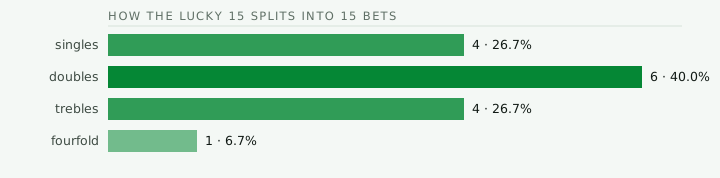
A Lucky 15 covers every single, double, treble and the fourfold across four selections. That comes to 15 separate bets, so a £1 Lucky 15 costs £15.00 rather than £1 — and £30.00 if you place it each way.
| Line type | Number of bets | Share of the bet |
|---|---|---|
| singles | 4 | 26.7% |
| doubles | 6 | 40.0% |
| trebles | 4 | 26.7% |
| fourfold | 1 | 6.7% |
| Total | 15 | 100% |
A worked example of Lucky 15 returns
Take four selections at 2/1, 6/4, 3/1 and evens, staked at £1.00 a line with every selection winning. The figures below come from the same calculation the tool above runs.
- Unit stake
- £1.00
- Total stake
- £15.00
- Returns
- £209.00
- Profit
- +£194.00
| Selection | Fractional | Decimal |
|---|---|---|
| 1 | 2/1 | 3.00 |
| 2 | 3/2 | 2.50 |
| 3 | 3/1 | 4.00 |
| 4 | 1/1 | 2.00 |
When a Lucky 15 is the right bet, and what the bonus is worth
The appeal of the Lucky 15 is that it fails gracefully. A four-fold accumulator pays nothing at all if one leg lets you down, but a Lucky 15 covers the four singles as well, so a single winner still returns money. You pay for that safety net: the bet costs 15 units rather than one, so a £1 Lucky 15 costs £15 rather than £1. That is the first thing the Lucky 15 calculator makes obvious, because the total stake moves with the unit rather than staying where you expect it.
That trade-off is the whole decision. If your four selections are short-priced favourites, the singles do most of the work and the multiples rarely land, which means you are paying a large stake for a modest return. If your selections are bigger prices, the multiples carry the value and the singles act as insurance. Working the numbers through before you place the bet is the only way to see which situation you are actually in.
Most bookmakers attach a bonus to a Lucky 15, and it is the part people most often forget to account for. The two common structures are an uplift on the odds when exactly one of your four selections wins, and a percentage bonus added to your total return when all four win. Both change Lucky 15 returns substantially, and neither is standardised across the industry, so this Lucky 15 bet calculator lets you enter whatever bonus your bookmaker actually offers rather than assuming a figure.
One more detail that catches people out is the non-runner. If one of your four horses is withdrawn, the bet does not lose that portion of the stake. The selection is treated at odds of 1.00, so every line that included it simply drops a leg: your fourfold becomes a treble, your trebles become doubles, and the single on that horse is returned. Set the leg to "void" in the Lucky 15 calculator and it settles exactly the way the bookmaker will — including the way a withdrawal quietly reduces your Lucky 15 returns across ten of the fifteen lines at once.
What it does well
- One winner returns money, unlike a Yankee
- Bookmaker bonuses can add meaningfully to the return
- Non-runners reduce the bet rather than killing it
What it costs you
- Costs 15 units, so the stake adds up quickly
- Short-priced selections rarely justify the outlay
- The bonus terms vary by bookmaker and are easy to misjudge
Settling a Lucky 15 each way
An each way Lucky 15 is 30 bets rather than 15, because every line is settled twice — once on the win terms and once at the place fraction the race is paying. A £1 each way Lucky 15 therefore costs £30, and that doubling catches people out more often than any other feature of the bet.
The place half can carry a surprising amount of the value on longer-priced selections. At a quarter of the odds, a 12/1 winner contributes a place return of 3/1 alongside the win return, and every double, treble and fourfold in the place half compounds at those reduced prices. Set the place terms in the Lucky 15 calculator above and both halves settle together.
Lucky 15 questions
How many bets are in a Lucky 15?
Fifteen: four singles, six doubles, four trebles and one fourfold. That is every possible combination of your four selections, which is why a single winner still produces a return.
How much does a £1 Lucky 15 cost?
A £1 Lucky 15 costs £15, because the unit stake applies to each of the 15 bets. Placed each way it costs £30, since each of the 15 lines is doubled into a win part and a place part.
Do I get a bonus if only one selection wins?
Many bookmakers apply an uplift to the odds of your single winner when exactly one of the four wins, and a percentage bonus on the whole return when all four win. The terms differ between firms and can exclude non-runners, so enter your own bookmaker’s figures in the bonus fields rather than assuming an industry standard.
What happens to a Lucky 15 if a horse is a non-runner?
The withdrawn selection is settled at odds of 1.00, so it neither wins nor loses. Your fourfold becomes a treble, each treble that contained it becomes a double, and the single is returned. Mark that leg as void in the calculator to see the exact settlement.
Is a Lucky 15 better than four singles?
It depends entirely on the prices. Four singles cost four units and return only what the winners pay. A Lucky 15 costs 15 units but adds the multiples, so it needs either bigger prices or multiple winners to beat the simpler bet. Run both through the calculator with your actual odds and compare.
Can you place a Lucky 15 each way?
Yes. An each way Lucky 15 doubles the stake to 30 units and settles two complete sets of 15 bets, one on the win terms and one on the place terms. Set the place fraction to match the race and the calculator settles both halves.
What is the difference between a Lucky 15 and a Yankee?
They use the same four selections, but a Yankee is 11 bets and leaves out the singles, so it needs at least two winners to pay anything. A Lucky 15 adds the four singles for four extra units of stake.