
Dutching calculator: back several runners for the same return
Dutching spreads one stake across several selections in the same event so that whichever of them wins, the return is identical. It turns a group of runners into a single bet at a combined price.
How dutching differs from arbitrage
The arithmetic is identical — stakes are split in proportion to implied probability so every covered outcome returns the same. The difference is what you are covering and why.
Arbitrage covers every outcome of an event, so the return is guaranteed. Dutching covers only the selections you fancy, so the bet still loses if something else wins. You are not eliminating risk; you are converting several opinions into one position at a combined price.
That combined price is the number to judge. Backing three horses whose implied probabilities total 60% gives you an effective price of about 1.67, and the bet is only worth making if you genuinely believe the three of them win more than 60% of the time between them.
When dutching earns its place
It works best when you can confidently eliminate most of a field but cannot separate two or three at the top. Rather than guessing between them and being right a third of the time, you back all of them and accept a shorter price for a much better strike rate.
It also has a practical use in each way racing markets and in football where you might want to cover several correct scores or a range of goal outcomes. Anywhere your genuine opinion is "one of these, but I do not know which", dutching expresses that opinion more honestly than picking one.
The trap is using it to avoid making a decision. Adding a fourth and fifth selection you do not really rate drags the combined price down while barely improving the strike rate, and the bet quietly becomes bad value. If a selection would not be worth backing on its own at a fair price, adding it to a dutch does not improve matters.
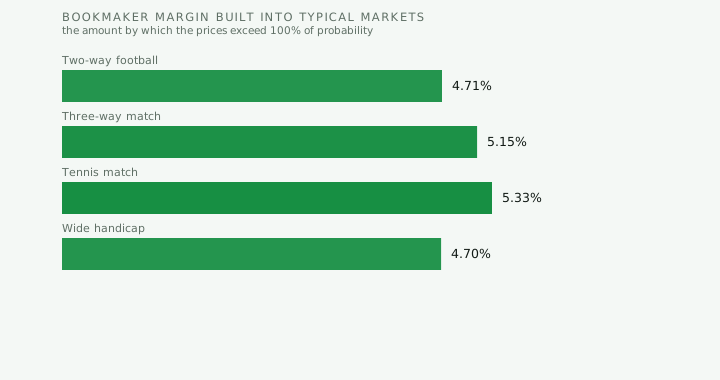
Dutching also has a use that has nothing to do with picking winners. If you have taken a position and the market has moved, spreading a second stake across the other outcomes can bring your book closer to level without needing an exchange account at all. It is a cruder instrument than laying, because you are paying bookmaker margin on every leg rather than commission on one, but it is available to anyone with two bookmaker accounts.
The number worth watching is always the combined implied probability. Once the selections you are covering add up to more than about 85% of the book, the return on a winner becomes so short that a single losing race wipes out several winning ones. At that point you are not reducing variance, you are grinding against the margin, and the arithmetic stops working long before it feels like it should.
Dutching calculator questions
What is dutching in betting?
Backing more than one selection in the same event with stakes proportioned so that any winner returns the same amount. It converts several selections into a single position at a combined price.
How do you work out dutching stakes?
Convert each price to implied probability, add them, then split the total stake in proportion to those probabilities. Every selection then returns the same figure if it wins.
Is dutching better than an each way bet?
They solve different problems. Each way pays a reduced price if your selection finishes placed; dutching pays a full return if any of several selections wins. On a race where you like three runners, dutching is usually the better expression of that view.
Does dutching guarantee a profit?
No. Unlike arbitrage it does not cover every outcome, so the whole stake is lost if a selection you did not back wins. It reduces variance, not risk.
How many selections should I dutch?
As few as express your actual opinion. Every additional selection shortens the combined price, so adding runners you do not genuinely rate makes the bet worse rather than safer.