
Betting guides: odds, value and bankroll management explained
Three guides covering the ideas the calculators assume you already know. No tips, no systems — just the mechanics of how prices, probability and staking actually work.
-
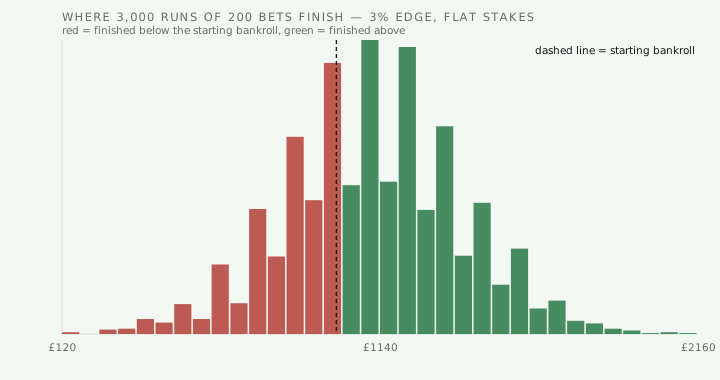 Bankroll management for betting Bankroll management is the part of betting that decides whether an edge ever gets the chance to show. Most people who lose money betting do not lose it because they picked badly — they lose it because they staked badly.
 -
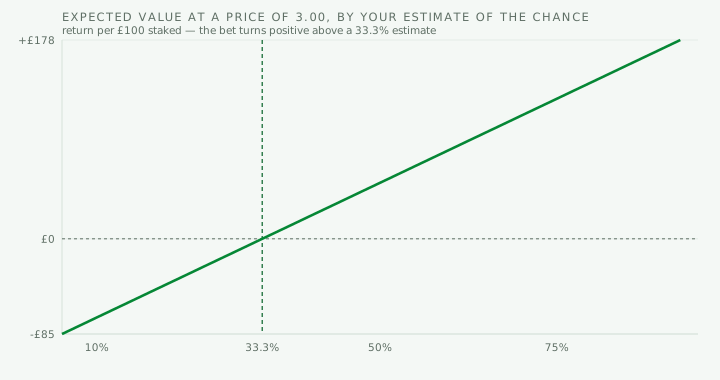 Value betting explained Value betting means backing selections at prices longer than their real chance justifies. It has nothing to do with picking winners, and understanding that distinction is most of the battle.
 -
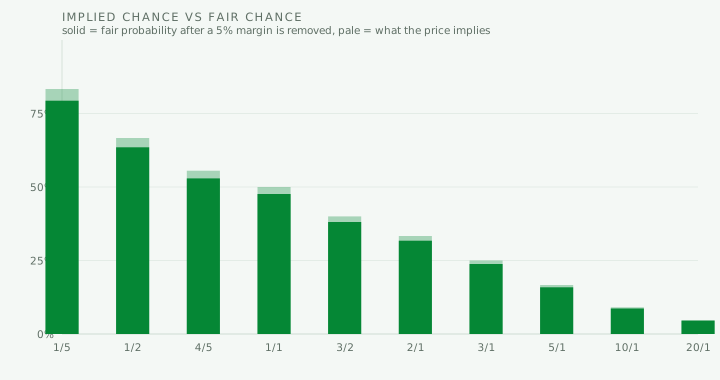 Understanding betting odds A price is a statement about probability with a charge added on top. Once you can read both parts, most betting decisions become clearer — and some of them become obviously bad.
The order these ideas build in
These three guides are deliberately sequential, because each one depends on the one before it. Reading them out of order tends to produce the situation where someone can recite what expected value means but cannot say whether 11/4 is a good price, which is precisely the gap the sequence is designed to close.
Understanding betting odds comes first. It covers converting between fractional and decimal, reading implied probability, and — the part that changes how markets look — recognising that every set of prices adds up to more than 100% of probability. That excess is the bookmaker margin, and until you can see it, you are reading the charge as though it were part of the opinion.
Value betting builds directly on that. Once you can turn a price into a probability and strip the margin out, the definition of a value bet becomes concrete rather than abstract: a price longer than the real chance justifies. The guide also covers the three places an edge can honestly come from, and the awkward fact that the most reliable evidence of one is not profit but closing line value.
Bankroll management comes last, because it is the part that decides whether an edge ever gets to matter. Most people who lose money betting do not lose it because they picked badly — they lose it because they staked badly, and a run of eight or ten losses at the wrong unit size ends the experiment before any edge has a chance to show through the noise.
What these guides deliberately leave out
There are no selections, no tipping, and no systems here. That is not modesty — it reflects what can honestly be written down. Whether a particular horse is well handicapped on Saturday is a question about horses; whether a price is longer than the probability justifies is a question about arithmetic, and only the second one generalises.
They also avoid the language of certainty that surrounds a lot of betting content. A positive expected value calculation is a statement about a long-run average built on an estimate you supplied, not a prediction. The bankroll simulator exists partly to make that concrete: run a genuine three percent edge through two hundred bets and watch how many of the three thousand simulated runs still finish down.
If gambling has stopped being something you enjoy, the support page lists free and confidential help, including the National Gambling Helpline on 0808 8020 133.
The three numbers worth being able to convert in your head
Almost everything in betting maths reduces to moving between three representations of the same thing: a fractional price, a decimal price, and a probability. Being able to do that quickly, approximately, without a calculator is the single highest-leverage skill in the subject.
Fractional to decimal: divide and add one. 5/2 is 2.5 plus 1, so 3.50. Decimal to probability: divide one by it. 3.50 gives 28.6%. Probability back to a fair price: divide one by the probability. A one-in-four shot is 4.00, or 3/1.
Once those are automatic, betting questions stop being vague. "Is 11/4 a good price on this?" is unanswerable. "Does this win more often than about 27% of the time?" is a question you can reason about using what you know about the sport. That translation is the whole job, and the odds converter is there for the cases where the arithmetic is awkward rather than as a substitute for the habit.
What these guides assume, and what they refuse to assume
They assume you can add, that you are prepared to be told something unwelcome, and that you would rather understand a mechanism than memorise a rule. They do not assume any statistical background, and where a piece of maths genuinely matters it is worked through rather than asserted.
What they refuse to assume is that betting is solvable. Everything here describes how prices, probability and staking behave; none of it describes a method for winning, because a method that reliably won would not survive being published. The most useful thing an honest guide can do is make the costs visible — the margin in every price, the way it compounds across an accumulator, the length of a normal losing run — so that decisions are made with the real numbers rather than the advertised ones.
If that sounds discouraging, it is worth saying the opposite too: the maths is not difficult, the tools that matter are free, and the people who lose most are usually losing to arithmetic they never checked rather than to bad luck.
Common claims these guides disagree with
"Chase your losses back with bigger stakes." Doubling after a loss produces frequent small wins and rare catastrophic ones, and it needs both an infinite bankroll and no maximum stake to work. Bookmaker limits alone break it. Nothing about a sequence of past results changes the probability of the next one.
"Accumulators are the value bet because the returns are huge." The returns multiply and so does the margin. A modest charge per leg compounds into a substantial one across five, and it is invisible on the slip because the headline figure still looks large.
"I'm up over the last month, so the system works." A month is noise. With a realistic edge, a meaningful share of two-hundred-bet sequences finish down purely through variance, and an equal share of losing strategies finish up. Closing line value answers the question far sooner than profit does.
"Free bets are free money." They are stake-not-returned, so the realisable value is the profit portion only, and they are worth proportionally less the shorter the price you use them at.
None of these are contrarian positions. They follow directly from arithmetic in the three guides above, which is the reason those guides exist rather than a page of tips.
A short glossary for the rest of the site
Implied probability — the chance a price corresponds to, found by dividing one by the decimal odds. A price of 4.00 implies 25%.
Overround, margin or vig — the amount by which a market total exceeds 100% of probability. It is the bookmaker charge, embedded in every price rather than itemised anywhere.
Fair price — the price a selection would carry with the margin removed. Beat it and the bet has positive expected value; fall short and it does not, however attractive the number looks.
Expected value — the average result of a bet per attempt across many repetitions. It says nothing about any single bet and everything about a long run of them.
Closing line value — whether the price you took beat the price the same bet settled at when the market closed. The fastest honest measure of whether you have an edge.
Stake-not-returned — the rule governing almost all free bets: winnings are paid as though you staked, but the stake itself is not returned. It is why a £10 free bet at 3.00 pays £20 rather than £30.
Risk of ruin — the chance a bankroll is lost entirely before an edge has time to show. Driven by stake size relative to bankroll far more than by the size of the edge.
Questions about betting maths
Where should I start if I am new to betting maths?
With the odds guide. Almost every other idea — value, expected value, margin, staking — assumes you can move between a price and a probability in your head. Once that conversion is automatic the rest follows quickly.
Do these guides give betting tips?
No. They explain how prices, probability and staking work, and they deliberately stop short of telling you what to back. No page on this site publishes selections or predictions.
What is the single most useful thing to understand about odds?
That a price is a probability with a charge added on top. A price of 4.00 implies a 25% chance, but the real market estimate is a little lower than that because bookmaker margin is built in. Reading both parts changes how every market looks.
How much of betting is skill and how much is luck?
Over a single bet, almost entirely luck. Over thousands of bets, a genuine edge of a few percent dominates. The uncomfortable part is that the sample size needed to tell the two apart is far larger than most people ever reach.
Is there a staking plan that beats the bookmaker margin?
No. Staking plans control volatility and risk of ruin; they cannot turn a losing proposition into a winning one. Any system claiming to profit from a negative edge is redistributing when losses arrive, not removing them.
Why do these guides keep mentioning sample size?
Because it is the thing most often ignored. Fifty bets tell you almost nothing about whether a method works, and both winning and losing runs of that length feel far more meaningful at the time than they are.