
Value betting explained: backing prices longer than they should be
Value betting means backing selections at prices longer than their real chance justifies. It has nothing to do with picking winners, and understanding that distinction is most of the battle.
The idea in one paragraph
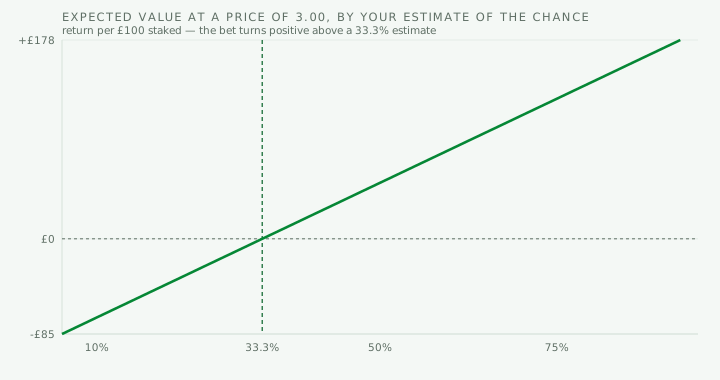
Every price implies a probability. Decimal odds of 4.00 imply a 25% chance. If you believe the real chance is 30%, the price is longer than it should be and the bet has value — not because it will win, but because at that price it will win often enough to profit over many repetitions.
This means a value bet can be an outsider that loses nine times in ten. It also means backing a winner at a short price can be a bad bet. Value is a property of the price relative to the probability, and it is entirely separate from whether any individual bet comes in.
Almost every misunderstanding about value betting traces back to this point. People evaluate bets by whether they won, which is the one piece of information that says least about whether the decision was correct.
Where an edge can actually come from
There are three honest answers. You know something the market has not priced — genuine specialist knowledge of a small league or a minor sport where bookmakers pay less attention. You model something better than the market does, which requires real statistical work and a data source worth having. Or you exploit a discrepancy between bookmakers without needing an opinion at all.
The third is the most accessible and the least glamorous. Take the sharpest available price, strip the margin out with the no-vig calculator, and use that as your probability estimate. Any bookmaker offering longer than that fair price is offering value, and you never had to form a view about the event.
What is not a source of edge: following tipsters, betting on the team you support, systems based on recent results, and anything that involves the word "due". Those feel like methods and are not.
Measuring whether you actually have an edge
Profit is a poor measure over anything short of several hundred bets, because variance dominates. The better measure is closing line value: whether the price you took was longer than the price that bet settled at when the market closed.
The logic is that the closing price is the market's most accurate estimate, having absorbed all available information and money. Consistently beating it means you identified something before the market did, which is what an edge is. Someone who beats the closing line by 2% across a thousand bets has demonstrated skill even if variance left them level.
It also fails fast, which is its most useful property. If you are consistently taking prices that shorten after you bet, you are picking up something real. If your prices consistently drift, the market disagrees with you and is usually right.
The part nobody mentions in the pitch
Accounts that consistently beat the closing line get restricted. Stake limits fall, prices get worse, and eventually the account is closed to new business. This is not a risk to manage — it is the normal outcome, and it usually arrives faster than people expect.
Betting exchanges are the structural answer, since they take commission on winnings rather than profiting from customer losses, and a winning customer generates more commission rather than less. The trade-off is that commission eats into thin margins and liquidity on smaller markets can be limited.
Being clear-eyed about this changes what a realistic plan looks like. Value betting with bookmakers has a shelf life per account; value betting on exchanges is sustainable but harder to make pay. Anyone describing it as a straightforward income is leaving out the half that determines whether it lasts.
Questions
What is value betting?
Backing a selection at odds longer than its true probability justifies. It is about the relationship between price and chance, not about predicting which selection will win.
How do I find value bets?
Compare a bookmaker price against a fair price. The cheapest reliable method is to take the sharpest market available, remove the margin with a no-vig calculator, and look for prices elsewhere that beat the result.
Can a losing bet still be a value bet?
Yes, routinely. A bet at 10.00 with a genuine 15% chance is excellent value and still loses most of the time. Value is judged on the price relative to the probability, not on the outcome.
What is closing line value?
The difference between the price you took and the price the same bet settled at when the market closed. Consistently beating the closing line is the most reliable evidence of an edge, and it shows up over a far smaller sample than profit.
Is value betting profitable?
It can be, but the constraint is usually account restrictions rather than the maths. Bookmakers limit accounts that beat them consistently, which is why sustained value betting tends to migrate to exchanges.
How much value should I look for?
Small edges are real but need very large samples to show through variance, and they are easily wiped out by an inaccurate estimate. Many bettors ignore anything under about 2% as being within the margin of error of their own method.