
Expected value calculator: the EV of a betting stake
The expected value of a bet is what it is worth on average if you could make it over and over. Enter the price on offer and your own estimate of the chance, and this expected value betting calculator tells you whether the bet is worth making at all.
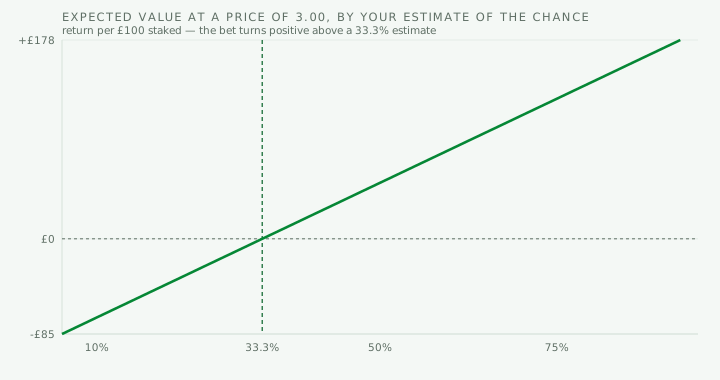
How the EV of a bet is calculated from a fair price
The expected value calculator multiplies each possible outcome by its probability and adds the results together. For a simple bet there are two outcomes: you win the profit, or you lose the stake. The formula is the chance of winning times the profit, minus the chance of losing times the stake.
Take a £10 bet at 3.00 where you believe the true chance is 40%. Winning pays £20 profit, and 40% of £20 is £8. Losing costs £10, and 60% of £10 is £6. The expected value is £8 minus £6, which is £2 — a 20% return on stake. That does not mean you will make £2. It means that if this exact situation repeated many times, you would average £2 per bet.
The number that matters underneath all this is the fair price. A 40% chance corresponds to a fair price of 2.50, because one divided by 0.40 is 2.5. Anything longer than 2.50 is a positive expected value bet; anything shorter is negative. Once you can compute a fair price, expected value becomes a straightforward comparison.
The honest problem with expected value betting
Every expected value calculator depends entirely on your probability estimate, and that estimate is the one thing the calculator cannot check. Feed in an optimistic number and you get an optimistic answer, dressed up in decimal places that make it look objective.
This is worth being blunt about, because expected value is often presented as though it removes judgement from betting. It does the opposite: it concentrates all the judgement into a single input and then does arithmetic on it. The arithmetic is trivially correct. The input is where the difficulty lives.
The practical defence is to test your estimates against something external. If your numbers consistently say the market is wrong by ten points, the more likely explanation is that your model is wrong. Comparing your estimate with the no-vig market price is a cheap sanity check: the market is not always right, but it is right often enough that large disagreements deserve scrutiny.
EV, fair price and closing line value
Because true probabilities are unobservable, people who take expected value betting seriously often track closing line value instead. If you consistently take prices longer than the price the same bet settles at when the market closes, you are beating the market, and that is measurable without knowing any true probability.
The two ideas fit together. The expected value of a bet is the theory of why it is good; closing line value is the evidence that your judgement of it was sound. A bettor who beats the closing line over hundreds of bets has demonstrated an edge in a way that a spreadsheet of self-assessed EV never can.
Expected value calculator questions
What is expected value in betting?
The average amount a bet wins or loses per attempt, given the price and the real chance of the outcome. Positive expected value means the price is longer than the true odds; negative means it is shorter. It describes a long-run average, not what will happen on any single bet.
How do I calculate the expected value of a bet?
Multiply the chance of winning by the profit if it wins, then subtract the chance of losing multiplied by the stake. A £10 bet at 3.00 with a 40% chance gives (0.40 × £20) − (0.60 × £10) = £2.
What is a good EV percentage?
Anything positive is theoretically worth taking, but small edges need very large samples to show up and are easily wiped out by an inaccurate estimate. Bettors who track results seriously tend to treat anything under about 2% as noise rather than an edge.
Can expected value be negative and the bet still win?
Yes, constantly. A negative EV bet at 10.00 still wins roughly one time in ten or better. Expected value describes the average over many repetitions and says nothing about any individual result.
Why is my EV calculation different from a bookmaker's implied odds?
Because the bookmaker price includes margin. The implied probability of a single price overstates the real chance the market assigns. Strip the margin out with the no-vig calculator first if you want to compare your estimate against the market's genuine view.
Does positive expected value guarantee profit?
No. It shifts the average in your favour, but variance dominates over short runs, and accounts that consistently find positive EV tend to get restricted. It is a necessary condition for long-run profit, not a sufficient one.