
Arbitrage calculator: split your stake across bookmakers
Arbitrage betting starts when different bookmakers disagree enough about the same event that the combined prices add up to less than 100% of probability. This arbitrage calculator works out how to split a stake across them and what position an arbitrage bet leaves you in.
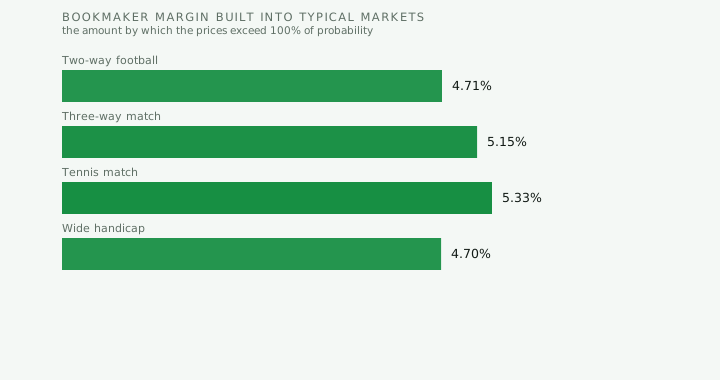
How an arbitrage bet works arithmetically
Convert every price to implied probability and add them together. If the total comes to less than 100%, the prices are collectively generous enough that a correctly proportioned stake on every outcome returns more than it costs, no matter what happens.
The arbitrage calculator derives the stake split directly from the prices: each outcome gets a share proportional to its implied probability, so that every outcome returns the same amount. Two prices of 2.10 total 95.2% of probability, so £50 on each side of a £100 stake returns £105 either way — a 5% margin.
This is arithmetic, not prediction. Nothing in it requires an opinion about the event. What it requires is that both prices remain available at the moment you place both bets, which is the part that turns a clean piece of mathematics into a difficult practical exercise.
Why arbitrage betting is harder than it looks
Arbitrage betting is unforgiving about timing: prices move fastest exactly when a discrepancy appears. Placing the first leg and finding the second has shortened leaves you with an ordinary single bet you did not intend to make, at a price you did not choose. Doing this at scale means accepting that some proportion of attempts will end this way.
Bookmakers also restrict accounts that do it. Stake factors get cut, maximum bets fall to a few pounds, and eventually the account is closed to new business. This is not a hypothetical risk; it is the normal outcome, and it usually arrives within weeks rather than months.
There is also the mundane failure mode of getting a leg wrong — the wrong market, the wrong handicap line, a rule difference between two firms about what happens if the event is abandoned. A locked position that is not actually locked is worse than no position at all, because the stake is now larger than you would ever have bet on one side.
Stake sizing on exchanges rather than bookmakers
Betting exchanges change the economics of an arbitrage bet considerably. An exchange takes commission on winnings rather than profiting from your losses, so a customer who wins consistently is a good customer rather than a problem. Accounts do not get restricted for winning.
The trade-off is that commission eats into an arbitrage calculator's headline margin, which is thin to begin with. A 5% arbitrage margin can become 2% or less after commission on the winning side, and exchange liquidity on smaller markets may not accommodate the stake you want. The hedge calculator handles the back-and-lay arithmetic with commission built in.
Arbitrage calculator questions
What is arbitrage betting?
Backing every outcome of an event with different bookmakers at prices that collectively add up to less than 100% of probability, so that the same amount comes back whichever result occurs. It relies on bookmakers disagreeing, not on predicting anything.
How do you calculate arbitrage stakes?
Give each outcome a share of the total stake proportional to its implied probability. Divide one by each price, add the results, then split the stake in that ratio so every outcome returns the same figure.
Is arbitrage betting legal in the UK?
Yes. Arbitrage betting breaks no law. It does, however, breach the terms of business of most bookmakers, who reserve the right to restrict or close accounts, and they use that right routinely.
Why did my arbitrage lose money?
Almost always because one leg was placed at a different price than intended, because the two bets were not actually on complementary outcomes, or because the firms settled a void or abandoned event under different rules.
How long do arbitrage opportunities last?
Usually seconds to a few minutes on liquid markets. The larger the apparent margin, the more likely it reflects an error or a price that has already moved rather than a genuine opportunity.
Do bookmakers ban you for arbitrage?
They restrict rather than ban in most cases — stake limits fall far enough that the account stops being usable. It is the normal outcome for accounts that do this consistently, and it usually happens quickly.