
No-vig calculator: strip the bookmaker margin and find the fair price
Bookmaker prices always add up to more than 100% of probability. The excess is the margin. Enter every price in a market and this strips it out, leaving the fair odds the prices actually imply.
What the overround is and why it exists
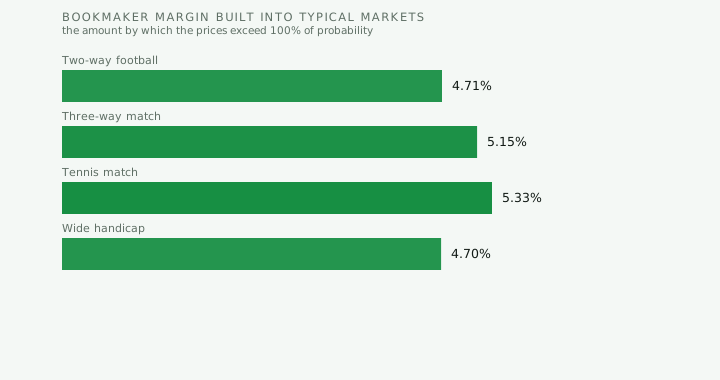
Convert every price in a market to implied probability and add them up. In a fair market the total would be exactly 100%. In a real one it is always more — typically 102% to 107% on a football match, and considerably more on markets with many runners. That excess is the overround, also called the vig or the juice.
It exists because a bookmaker who priced every outcome fairly would make nothing. Building in a few percent means that a balanced book profits regardless of the result. It is the price of the service, and it is entirely legitimate — but it means the prices you see are systematically shorter than the market's genuine opinion.
Two prices of 1.91 each imply 52.4%, and together that is 104.8%. The market thinks each side is a 50% chance; the 4.8% is margin. If you assume 1.91 means "the bookmaker thinks this is a 52.4% shot", you will consistently misjudge how confident the market actually is.
How the margin is removed
The simplest method, and the one this calculator uses, divides each implied probability by the total. Two prices at 52.4% each divided by 104.8% give 50% each, so the fair price on both sides is 2.00. This is called proportional or multiplicative devigging.
It has a known weakness: margin is not usually spread evenly across a market. Bookmakers load more of it onto longshots, which is the well-documented favourite-longshot bias. In a market with a 1.20 favourite and a 15.00 outsider, proportional devigging will slightly overstate the outsider's fair chance.
More sophisticated methods exist — additive, power and Shin devigging all attempt to model where the margin is concentrated. For two-way markets with prices near evens, the differences between them are tiny, and the proportional method is a perfectly good working tool. On lopsided multi-runner markets, treat the output as an approximation rather than a precise figure.
Using fair prices as a benchmark
The most valuable use of a no-vig price is as a reference point. If a market's fair price on a selection is 2.20 and another bookmaker is offering 2.40, you have found a genuine discrepancy without needing any opinion of your own about the event.
This is the mechanism behind most systematic value betting. Rather than forming an independent view, you use the sharpest available market as your estimate of true probability and look for prices elsewhere that beat it. It requires no expertise in the sport at all — only the discipline to compare consistently and the acceptance that accounts finding these prices tend to get limited.
No-vig odds calculator questions
What does no-vig mean in betting?
It means the price with the bookmaker margin removed — the odds that would apply if the market added up to exactly 100% of probability. It is an estimate of what the market genuinely thinks, rather than what it is charging.
How do you calculate no-vig odds?
Convert each price to implied probability, add them all up, then divide each one by that total. The results sum to 100%, and one divided by each gives the fair price.
What is a normal bookmaker margin?
Around 2% to 5% on major two-way football and tennis markets, 4% to 8% on three-way match odds, and considerably more on outright and multi-runner racing markets where it can exceed 20%.
Is the no-vig price the true probability?
No, it is the market's estimate with the charge removed. Markets are usually well calibrated but not perfect, and the proportional method used here spreads margin evenly when in reality it is loaded more heavily onto longshots.
Why do accumulator odds get worse with every leg?
Because the margin compounds. A 3% margin on each of five legs does not stay 3% — it multiplies out to roughly 16% on the accumulator. This is the least visible reason long multiples are poor value.