
Kelly criterion calculator: size your stake from your edge
The Kelly criterion works out the stake that maximises long-run bankroll growth for a given edge. It is the most mathematically defensible staking method there is, and almost nobody should use it at full strength.
What the Kelly formula does
Kelly stakes a fraction of your bankroll equal to your edge divided by the odds you are getting. Written out for betting, that is the probability of winning multiplied by the decimal odds, minus one, divided by the odds minus one.
A price of 3.00 with a true chance of 40% gives an edge of 20%: 0.40 × 3.00 = 1.20, so you are getting 20% more than a fair price. Dividing that edge by the net odds of 2.00 gives a Kelly fraction of 10% of bankroll. With £1,000 that is a £100 bet, which strikes most people as alarmingly large — and that reaction is correct.
The formula proves something genuinely remarkable: staking this fraction maximises the long-run growth rate of a bankroll, and any other fixed fraction grows more slowly. It also never risks the whole bankroll, because the stake is always a proportion of what remains.
Why almost everyone should stake less than Kelly says
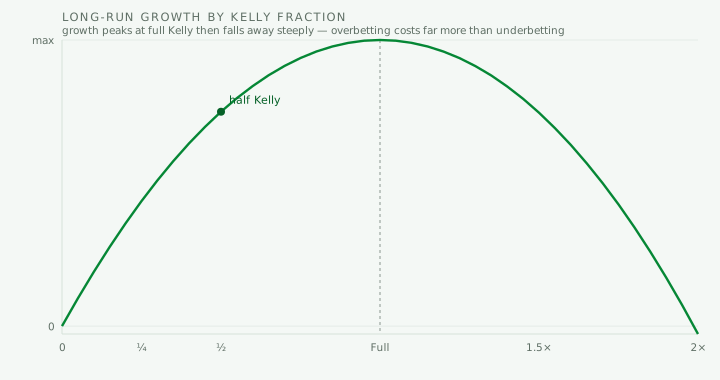
Full Kelly is optimal only if your probability estimate is exactly right. It never is. Overestimate your edge and you are not merely staking a bit too much — you are on the wrong side of a curve that turns steeply downward, and consistent overbetting reduces growth to zero and then below it.
Full Kelly is also extraordinarily volatile even when your estimate is perfect. Drawdowns of 50% or more are routine rather than exceptional. Most people discover their real risk tolerance somewhere in the middle of one, at which point they abandon the system and take the losses without the compensating upside.
Half Kelly gives up about a quarter of the theoretical growth rate while cutting variance roughly in half. Quarter Kelly gives up more still and is close to comfortable. Because the growth curve is flat near its peak and steep beyond it, staking less than optimal costs very little and staking more costs a great deal. That asymmetry is the whole practical argument for fractional Kelly.
When Kelly says do not bet
If the price is shorter than your fair price, the formula returns a negative number, which means the correct stake is zero. This is a feature rather than an edge case: a staking system that tells you when not to bet is doing something that a fixed-stake plan cannot.
It also means Kelly cannot be used without a probability estimate. Any staking plan that scales with confidence needs a number to scale from, and the discipline of producing that number — and being wrong about it in a measurable way — is arguably more valuable than the stake size it produces.
Kelly criterion calculator questions
What is the Kelly criterion?
A formula for the stake size that maximises long-run growth of a bankroll, given the price on offer and the true probability of winning. It stakes proportionally more when the edge is larger and nothing at all when there is no edge.
How do you calculate the Kelly stake?
Multiply your probability by the decimal odds and subtract one to get the edge, then divide by the decimal odds minus one. The result is the fraction of your bankroll to stake.
Should I use full Kelly?
Almost certainly not. Full Kelly assumes your probability estimate is exact, and the penalty for overestimating your edge is severe while the cost of staking less is small. Half or quarter Kelly is the usual compromise.
What is half Kelly?
Staking half the figure the formula produces. It surrenders roughly a quarter of the theoretical growth rate while cutting volatility by about half, which is a trade most bettors find worthwhile.
Why does Kelly recommend a zero stake?
Because the price you entered is shorter than the fair price implied by your own probability estimate. With no edge there is no stake that improves long-run growth, so the formula correctly returns nothing.
Does Kelly work if my probability estimates are wrong?
It degrades badly. Systematic overestimation of your edge leads to systematic overbetting, which can turn a genuine advantage into a losing strategy. Fractional Kelly is largely a defence against exactly this.