
Betting models: Poisson football probabilities and bankroll simulation
Two models that answer questions a calculator cannot. One turns a goals estimate into a fair price for every football market; the other shows what a staking plan actually does to a bankroll across thousands of runs.
The models
What a model is for
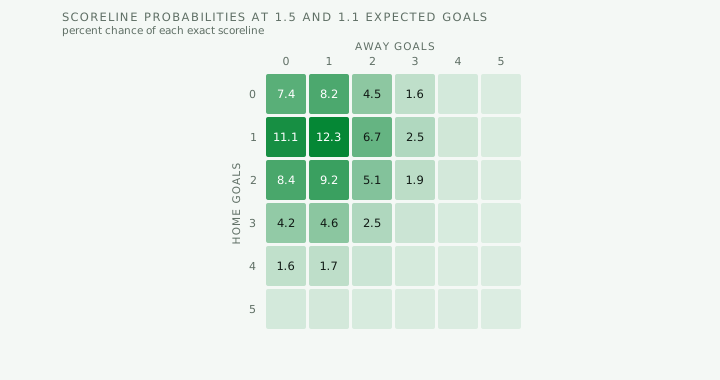
A model does not tell you what will happen. It tells you what follows from an assumption, which is a more modest claim and a far more useful one. Feed the Poisson calculator an estimate of how many goals each side will score and it returns a coherent probability for every scoreline, and therefore a fair price for the match result, the goals markets and both teams to score.
The value is in the coherence. Judged individually, opinions about a match result, over 2.5 goals and both teams to score can easily contradict each other. Derived from one goals estimate, they cannot. That internal consistency is what a model buys you, and it is why comparing model prices with bookmaker prices is more informative than comparing gut feelings with them.
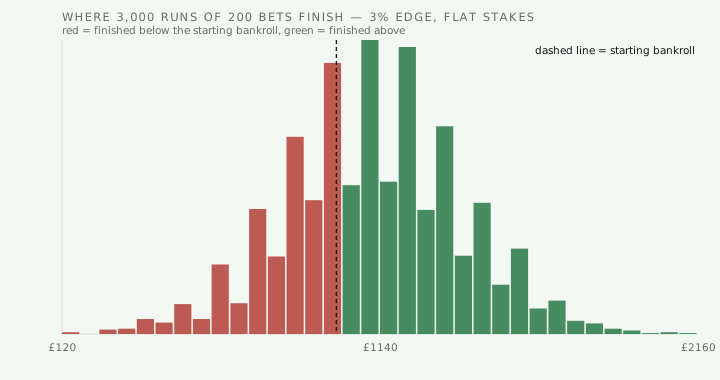
The bankroll simulator does the same job for staking. Everyone knows that variance exists; very few people have an accurate sense of how much of it there is. Running three thousand sequences of two hundred bets at a realistic edge makes the answer concrete, and it is usually sobering.
Being honest about model error
Both models here are deliberately simple, and both are wrong in documented ways. Plain Poisson treats goals as independent events, which they are not — teams change behaviour once the score changes, so real football produces more draws than the model expects. The simulator assumes an edge that is constant, known and available on every bet, which is not how betting works once accounts start getting restricted.
Neither of those makes the models useless. A tool that is wrong in a known direction is far more useful than one whose errors are unknown, because you can reason about the bias. What matters is not pretending the output is more precise than the inputs justify.
Why a model beats a strong opinion
The practical advantage of writing a model down is that it can be wrong in a way you can measure. An opinion held in your head adjusts quietly after the event, remembers its successes and forgets its misses, and never produces a number you can check. A model commits to a probability before the result and leaves a record.
That record is what makes improvement possible. If your Poisson inputs consistently overrate home sides, that bias shows up across fifty matches as a systematic gap between what you predicted and what happened, and you can correct for it. No amount of reflection on your own judgement produces the same information, because memory is not a dataset.
It also disciplines the bets you do not make. A model that gives a fair price of 2.10 when the market is offering 1.95 tells you clearly to pass, and it does so without the internal negotiation that usually accompanies talking yourself out of a bet you fancy. Most of the value in modelling is in the bets it stops you making rather than the ones it finds.
Calibration is the only test that matters
A model is well calibrated when the things it calls thirty percent happen about thirty percent of the time. That sounds obvious and it is remarkably rarely checked, because checking it requires keeping a record of predictions made before the event and comparing them with what actually happened.
Accuracy and calibration are not the same thing. A model that predicts the favourite every time will be accurate in a large majority of matches and completely useless for betting, because it never tells you anything the price did not already. What you need is a model whose probabilities are trustworthy at every level of confidence, especially the middling ones where most value lives.
The practical method is unglamorous. Record the probability your model assigned, bucket the predictions by that probability, and compare each bucket's predicted rate with its observed rate over a decent sample. Systematic gaps are corrections waiting to be made — if everything you call sixty percent lands seventy percent of the time, your model is underconfident in a fixable way.
How much variance to expect before you conclude anything
Most arguments about whether a betting strategy works are really arguments about sample size conducted by people who have not looked at the distribution. The bankroll simulator exists to replace that argument with a picture.
Run a genuine three percent edge over two hundred bets at even money, three thousand times, and a substantial share of those runs finish below where they started. Not because the edge is fake, but because two hundred bets is a short sequence and variance at that length is larger than intuition allows. The same edge over two thousand bets looks completely different.
This has a direct consequence for how you should read your own results. A losing month tells you almost nothing. A losing year tells you a little. Consistently beating the closing line over a few hundred bets tells you considerably more than either, which is why it is worth tracking even though it is less satisfying than counting money.
Reading a distribution instead of an average
The single most useful habit these models encourage is looking at the spread of outcomes rather than the middle of it. An average conceals everything that decides whether a strategy is survivable.
Two staking plans can produce the same expected finish while behaving completely differently. One drifts gently either side of its starting point; the other produces a majority of small gains and an occasional total loss. Their averages match. Only one of them is something a person can actually follow, and the difference is visible immediately in the distribution and not at all in the summary figure.
The same applies to a football model. A fair price of 2.40 on the draw is not a prediction that the match will be drawn; it is a statement that this scoreline pattern occurs about 42% of the time across many similar matches. Treating a probability as a forecast is how people conclude a well-calibrated model is broken after three results.
Both models here output distributions for that reason: the Poisson calculator gives a probability for every market rather than a tip, and the simulator gives percentiles rather than an expected return.
What a model cannot see
Both models here take a small number of inputs and are explicit about their assumptions, which makes their blind spots unusually easy to describe.
The Poisson model knows nothing about team news, weather, motivation, fatigue, or whether a side is already safe. It sees two expected-goals figures and assumes goals arrive independently at a constant rate. Real matches violate that constantly — a red card, an early goal, or a team that stops attacking once ahead all change the process the model treats as fixed.
The bankroll simulator assumes an edge that is real, constant, known in advance and available on every bet at the same price. In practice an edge is estimated rather than known, varies between bets, and frequently disappears when an account gets restricted. No simulation captures a bookmaker cutting your maximum stake to four pounds.
Neither limitation makes the models useless. A tool that is wrong in a documented direction is far more useful than one whose errors are unknown, because you can reason about the bias and adjust for it. What matters is not pretending the output is more precise than the inputs justify — which is exactly the failure mode of the confident prediction tools these two are the antidote to.
Betting model questions
What is a betting model?
A structured way of turning inputs into probabilities. A Poisson football model turns expected goals into a probability for every scoreline; a bankroll simulator turns an edge and a staking plan into a distribution of outcomes. Neither predicts a result — both make the consequences of an assumption explicit.
Do I need a model to bet profitably?
No, but you need something that plays the same role. A model is one way of producing a probability estimate that can be checked and improved. Judgement built on genuine expertise is another. What does not work is an estimate that is never written down and therefore never tested.
How accurate are football prediction models?
A well-specified Poisson model gets the broad shape of scoring right and is systematically wrong in known ways — it underprices draws and low-scoring games. That is why published models usually apply a correction. Accuracy depends far more on the quality of the inputs than on the sophistication of the maths.
Why does the bankroll simulator show losing runs with a positive edge?
Because that is what variance does. Over a few hundred bets a genuine edge is easily buried by normal fluctuation, which is precisely why short-term results tell you almost nothing about whether a strategy works.
Can I trust a model that has not been tested against real results?
No. A model that has never been checked against outcomes is a set of assumptions with arithmetic applied to it. The value comes from calibration — comparing what it predicted with what happened, repeatedly.