
Understanding betting odds: fractions, decimals and probability
A price is a statement about probability with a charge added on top. Once you can read both parts, most betting decisions become clearer — and some of them become obviously bad.
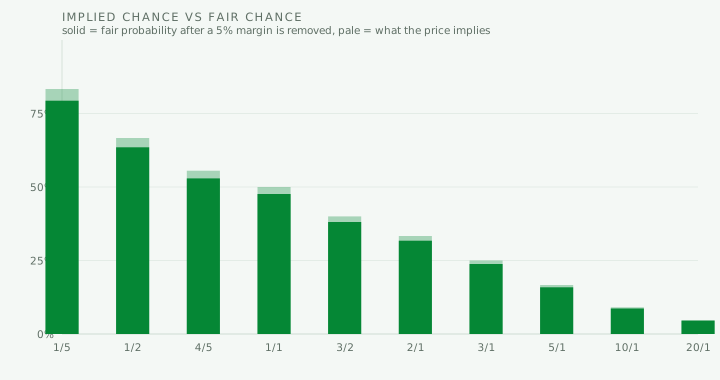
Fractional and decimal odds are the same thing
Fractional odds describe profit relative to stake. 5/2 means a £2 stake profits £5. Decimal odds describe total return including the stake, so the same price is 3.50: a £2 stake returns £7, which is £5 profit plus the £2 back.
Converting between them is one step in either direction. Divide the fraction and add one to get decimal; subtract one from decimal and express the remainder as a fraction. 5/2 is 2.5 + 1 = 3.50. Decimal 4.50 is 3.5, which is 7/2.
Decimal is easier for anything involving multiplication, which is why exchanges and models use it. Multiplying four decimal prices gives an accumulator price instantly; doing the same with fractions is needlessly painful. Fractional survives in Britain because it is what the boards and betting shops have always shown. The odds converter shows both alongside the implied probability.
Implied probability is the number that matters
Divide one by the decimal odds and you get the chance the price corresponds to. 4.00 implies 25%. 1.50 implies 66.7%. 11.00 implies 9.1%.
This is the single most useful conversion in betting, because it turns a price into something you can hold an opinion about. "Is 6/1 a good price?" cannot be answered. "Does this win more than one time in seven?" can be, at least approximately, and that is the same question.
Getting into the habit of making that conversion changes how markets read. A 1.20 favourite is not "nearly certain" — it is an 83% chance, which means it loses roughly one time in six. Anyone who has watched a short-priced favourite get turned over knows the feeling; the price said so all along.
The margin built into every price
Add up the implied probabilities of every outcome in a market and the total always exceeds 100%. Two prices of 1.91 imply 52.4% each, totalling 104.8%. That extra 4.8% is the bookmaker margin, and it is the reason a balanced book makes money regardless of the result.
The consequence is that implied probability systematically overstates the real chance. If you take 1.91 to mean the bookmaker thinks this is a 52.4% shot, you are reading the charge as part of the opinion. Stripping the margin out with the no-vig calculator gives a much better picture of what the market actually believes.
Margin also varies enormously by market. Major two-way football and tennis markets run at 2% to 5%. Three-way match odds are higher. Outright markets and big-field handicaps can exceed 20%, which is why they are so much harder to beat despite appearing to offer attractive prices.
Why accumulators get worse with every leg
Accumulator odds multiply, and so does the margin. A 3% margin on each of five legs does not stay 3% — it compounds to roughly 16% on the accumulator as a whole.
This is the least visible reason long multiples are poor value. The headline return looks enormous because the prices multiply, and they do; what also multiplies is the charge, quietly, in a way no part of the betting slip shows you.
None of which means never bet an accumulator. It means understanding that a fivefold is not five bets' worth of margin but considerably more, and pricing your enjoyment of the bet accordingly. The accumulator calculator shows the return; the margin is the part you have to reason about yourself.
Questions
How do you read betting odds?
Fractional odds show profit against stake, so 5/2 means £5 profit per £2 staked. Decimal odds show total return including stake, so the same price is 3.50. Dividing one by the decimal price gives the implied probability.
What does 5/2 mean in decimal odds?
3.50. Divide 5 by 2 to get 2.5, then add one to account for the stake being returned.
What is implied probability?
The chance of winning that a price corresponds to, found by dividing one by the decimal odds. Odds of 4.00 imply 25%. It always slightly overstates the real chance because bookmaker margin is built in.
Why do bookmaker odds add up to more than 100%?
Because the excess is their margin. A market that added up to exactly 100% would make the bookmaker nothing. The amount above 100% is what makes a balanced book profitable regardless of the result.
Are decimal odds better than fractional odds?
They are the same prices in different notation. Decimal is easier to compare and to multiply, which is why exchanges use it; fractional remains standard in British racing.
Why are accumulator odds worse value than singles?
Because the margin compounds along with the odds. A 3% margin on each of five legs works out to around 16% on the accumulator, even though the displayed return looks generous.