Odds converter: fractional to decimal and implied probability
This betting odds converter takes a price in any format and shows it in all four. Fractional for the British board, decimal for the exchanges, American for US sportsbooks, and the implied probability that tells you what the price actually means.
How to convert fractional to decimal odds
To go from fractional to decimal, divide the first number by the second and add one. Odds of 5/2 become 5 ÷ 2 = 2.5, plus 1, giving decimal odds of 3.50. The reason for adding one is that fractional odds describe your profit while decimal odds describe your total return including the stake back.
That single difference causes most of the confusion between the two formats. A 2/1 shot returns £30 from a £10 stake: £20 profit plus your £10 back. In fractional terms it is 2/1 because the profit is twice the stake. In decimal terms it is 3.00 because the total return is three times the stake. Neither is more correct — they are describing different halves of the same transaction.
Converting fractional to decimal is the step you need most often, because decimal is the format you multiply. Going the other way, subtract one from the decimal price and express what remains as a fraction. Decimal 4.50 minus 1 is 3.5, which is 7/2. British bookmakers round to a conventional ladder of fractions, so a decimal price of 4.40 will usually appear on the board as 7/2 rather than as the exact 17/5. A betting odds converter is worth keeping to hand precisely because that rounding is not obvious.
What implied probability tells you about a price
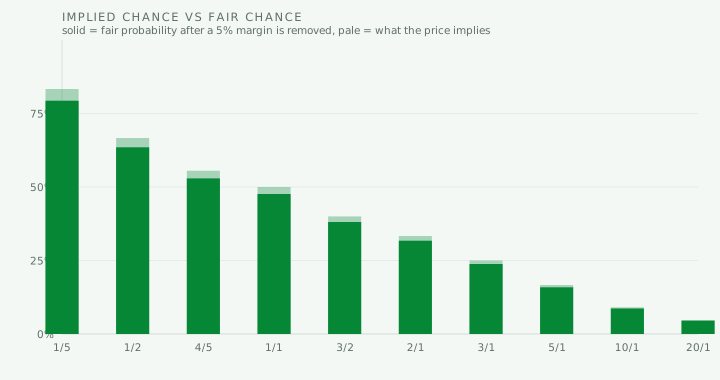
Implied probability is one divided by the decimal odds. A price of 4.00 implies a 25% chance; a price of 1.50 implies 66.7%. This is the most useful number on this page, because it converts a betting price into something you can actually have an opinion about.
The catch is that implied probabilities in a real market always add up to more than 100%. That excess is the bookmaker margin, and it means the implied probability of any single price is slightly overstated. If you want the market's genuine estimate rather than the padded one, run the whole market through the no-vig calculator instead.
Once you are comfortable moving between prices and probabilities, most betting questions become easier to answer. "Is 11/4 a good price?" is unanswerable on its own. "Is this a better than 26.7% chance?" is a question you can actually reason about.
Why American odds look so different
American odds are built around a 100-unit stake. A positive line such as +150 means a 100 stake profits 150, which is 5/2 or 3.50. A negative line such as -200 means you must stake 200 to profit 100, which is 1/2 or 1.50. The switch between positive and negative happens at evens.
You will meet the format on US sportsbooks and in most published betting models, so it is worth being able to read it even if you never bet into it. The converter shows all three formats at once precisely so you do not have to hold the conversion in your head.
Odds converter questions
How do you convert fractional odds to decimal?
Divide the first number by the second and add one. So 5/2 becomes 2.5 + 1 = 3.50, and 1/2 becomes 0.5 + 1 = 1.50. The extra one accounts for your stake being returned, which decimal odds include and fractional odds do not.
What does implied probability mean?
It is the chance of winning that a price corresponds to, calculated as one divided by the decimal odds. Odds of 4.00 imply a 25% chance. Because bookmaker margin is built into every price, the implied probability is always slightly higher than the market's genuine estimate.
Are decimal odds better than fractional?
Neither is better, but decimal is easier to compare and to multiply, which is why exchanges and models use it. Fractional remains standard on British racecourses and in betting shops. The prices are identical either way.
Why does 8/13 not convert to a round decimal?
Fractional odds are drawn from a traditional ladder of fractions that does not map neatly onto decimals. 8/13 is 1.615, which no bookmaker would display. When a decimal price falls between two rungs of the fractional ladder, it gets rounded to the nearest one — usually in the bookmaker's favour.
What do American odds of -110 mean?
You must stake 110 to profit 100, which is decimal 1.909 or fractional 10/11. It is the standard price for a two-way market with a normal margin, and it implies a 52.4% chance.