
Value betting tools: expected value, fair odds and stake sizing
These calculators work on prices rather than on settled bets. They answer a different question from the bet calculators — not what a bet paid, but whether it was worth making.
The value tools
- Expected value calculator The expected value of a bet is what it is worth on average if you could make it over and over.
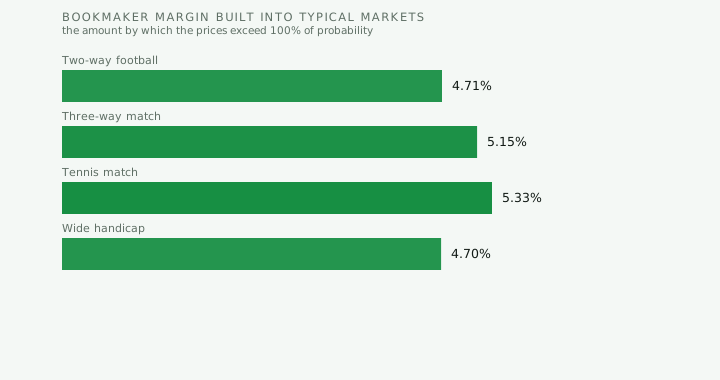
- No-vig odds calculator Bookmaker prices always add up to more than 100% of probability.
- Arbitrage calculator Arbitrage betting starts when different bookmakers disagree enough about the same event that the combined prices add up to less than 100% of probability.
- Kelly criterion calculator The Kelly criterion works out the stake that maximises long-run bankroll growth for a given edge.
- Dutching calculator Dutching spreads one stake across several selections in the same event so that whichever of them wins, the return is identical.
- Hedge calculator If a price has moved since you backed it, laying the same selection on an exchange converts a live bet into a fixed result.
How the value tools fit together
They form a sequence, and using them in order makes each one more useful than it is alone. Start with the no-vig calculator. Bookmaker prices always add up to more than 100% of probability, and until you strip that margin out you are comparing your own view against a number that has a charge built into it.
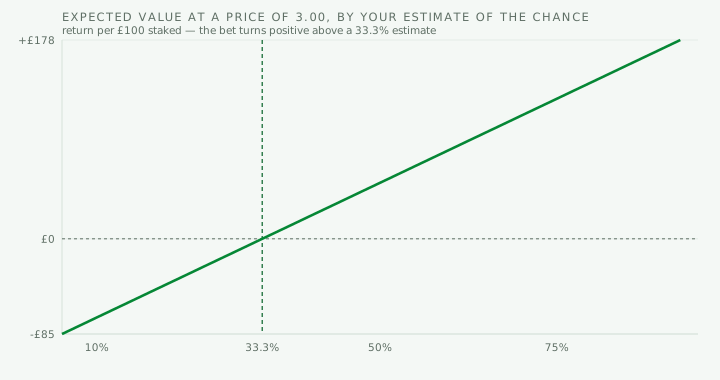
Once you have a fair price, the expected value calculator turns the comparison into pounds. It takes your estimate of the chance and the price on offer and tells you what the bet is worth per attempt on average. This is where most people meet the uncomfortable truth that a bet can feel obviously good and still be negative value.
If the value is positive, the Kelly criterion calculator answers the next question: how much to stake. Kelly scales the stake to the size of the edge, which is the mathematically defensible alternative to betting the same amount on everything regardless of confidence.
The remaining three tools cover situations where you are working with more than one price at once. Arbitrage covers every outcome so the result is fixed. Dutching covers several selections you fancy so any of them returns the same amount. Hedging closes an existing position by taking the other side on an exchange.
The limitation worth understanding before you start
Every one of these calculators is exact, and most of them are only as good as an estimate you supply. Expected value and Kelly both depend on a probability figure that no tool can verify. Enter an optimistic number and you get an optimistic answer expressed to two decimal places, which is a very effective way of making a guess look like a measurement.
The arbitrage and hedging tools are different, because they work purely on prices that are actually on offer and need no estimate at all. Their difficulty is practical rather than statistical: prices move while you are placing the second leg, and accounts that find these situations regularly get restricted quickly.
None of this is an argument against the tools. It is an argument for knowing which kind of uncertainty you are dealing with in each case — an estimate that might be wrong, or an execution that might not complete.
Closing line value, and why it is the honest scoreboard
The awkward truth about every expected value calculation is that it rests on a probability you supplied, and nothing in the arithmetic can tell you whether that number was any good. Profit does not settle the question either, at least not quickly: over a few hundred bets variance comfortably drowns out an edge of a few percent in either direction.
Closing line value sidesteps both problems. Instead of asking whether you were right about the event, it asks whether you were right about the price — did the market move towards you after you bet, or away? The closing price is the market's most informed estimate, having absorbed every piece of news and every pound of money. Beating it consistently means you saw something before the market did, which is what an edge actually is.
Its most useful property is speed. Profit needs hundreds of bets to say anything; closing line value gives a readable signal over dozens, because it measures each decision rather than each outcome. If your prices consistently shorten after you bet, something in your process is working even while you are losing. If they consistently drift, the market disagrees with you, and the market is usually right.
What happens to accounts that use these tools well
This deserves stating plainly, because most sites that publish value betting tools leave it out. Bookmakers restrict accounts that beat their prices consistently. Not occasionally, not only at extremes — routinely, and usually within weeks rather than months. Stake limits fall to a few pounds, the account stays technically open, and it stops being usable.
That is not a scandal; it is the rational behaviour of a counterparty losing money. But it does mean that a strategy built entirely on fixed-odds bookmaker accounts has a shelf life, and any description of value betting that omits it is selling something.
The structural answer is the betting exchange, where the venue earns commission on winnings rather than profiting from losses, so a winning customer is worth more rather than less. The trade-off is that commission eats into thin margins and liquidity outside major markets can be limited. That is a real cost, and it is a different kind of problem from having your account quietly switched off. The operator comparison marks which venues are exchanges for exactly this reason.
Where a probability estimate can honestly come from
Every tool on this page needs a number you supply, and the quality of that number decides whether the output means anything. There are three defensible ways to produce one.
Borrow it from a sharper market. Take the most efficiently priced venue available, strip its margin out, and use the result as your estimate. This requires no opinion about the event and is the most reliable method available to most people. It also has an obvious ceiling: you can only find prices that are worse than the reference, never insight the reference lacks.
Model it. Build something that turns inputs into probabilities and check it against outcomes over time. The Poisson model is the simplest honest example. The work is not the maths, which is standard, but the calibration — comparing what the model predicted with what happened, repeatedly, and correcting the gaps.
Know something. Genuine specialist knowledge of a small league or a minor sport that bookmakers price with less attention is a real edge and always has been. It is also the hardest to verify from the inside, because confidence and competence feel identical.
What does not work: recent results, gut feeling, and the sense that something is due. Those produce numbers, and the calculators will process them into confident-looking output, which is precisely the risk.
Using these tools in sequence on a real bet
The tools are more useful in order than individually, and one worked pass shows why. Suppose a market offers 2.10 and 1.85 on the two outcomes of a match, and a second firm is offering 2.30 on the first.
Start with the no-vig calculator. Those two prices imply 47.6% and 54.1%, totalling 101.7%. Stripping the margin proportionally puts the fair price on the first outcome at about 2.14 — what the market genuinely thinks, as opposed to what it is charging.
Now the 2.30 elsewhere is interesting, because it is longer than fair. Feed 2.30 and that fair probability into the expected value calculator and you get the edge in pounds per unit staked, which is a number you can act on rather than a feeling that a price looks generous.
Finally the Kelly criterion calculator turns that edge into a stake proportional to its size, and almost certainly a fraction of what full Kelly recommends. Three steps, no opinion about the sport required, and a defensible answer to both questions that matter: is this worth backing, and for how much.
Value betting questions
What are value betting tools?
Calculators that work on prices rather than on settled bets. They answer whether a price is worth taking — by stripping out bookmaker margin, comparing a price against your own probability estimate, or sizing a stake to the edge you believe you have.
What is value betting?
Backing selections at prices longer than their true chance justifies. It does not require predicting winners; it requires being right more often than the price implies, which is a much lower bar and a much harder one to verify.
Do I need to be good at maths to use these value tools?
No. Each calculator does the arithmetic and explains what the result means in plain terms. What they cannot do is supply the probability estimate — that judgement is yours, and it is the part that decides whether the output is meaningful.
Which value tool should I use first?
The no-vig calculator. Seeing how much margin is built into ordinary prices changes how you read a betting market, and it gives you a fair-price benchmark that every other tool on this page builds on.
Will using value tools get my account restricted?
Consistently taking prices that beat the market tends to attract stake restrictions from bookmakers, regardless of which tools you used to find them. Betting exchanges work differently, because they take commission on winnings rather than profiting from losses.
Can these tools guarantee a profit?
No. They show whether a price is favourable given the numbers you supply and whether a set of prices locks in a position. Prices move, estimates are wrong, and nothing here removes the risk from gambling.