
Rule 4 calculator: work out the deduction when a horse is withdrawn
When a horse is withdrawn too late to reprice the market, bookmakers deduct a fixed amount from winnings on the remaining runners. The size of the deduction depends on how well backed the withdrawn horse was.
Why Rule 4 exists
If a horse is withdrawn before a race but after bets have been struck, everyone else's chance of winning improves. Backers of the remaining runners would otherwise get a windfall — a price that reflected a field including a horse that is no longer in it.
Rule 4, named after the Tattersalls Committee rule that defines it, corrects for this by deducting a set amount from winnings. The deduction scales with how strongly the withdrawn horse was fancied: a withdrawn odds-on favourite changes the race enormously and carries a large deduction, while a 20/1 outsider changes almost nothing and carries none at all.
The deduction applies to winnings only, never to your stake. A £10 bet at 4/1 returns £50, of which £40 is winnings. A 25p deduction removes 25% of that £40, leaving £30 of winnings and a £40 return.
How the deduction scale works
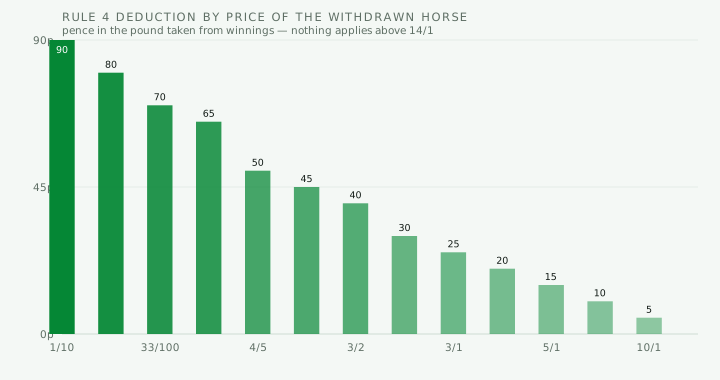
The scale runs from 90p in the pound for a horse at 1/9 or shorter down to nothing at all for anything longer than 14/1. It is banded rather than continuous, so every price within a band carries the same deduction.
The bands follow implied probability closely, which is why a withdrawn evens shot costs 45p while a 2/1 shot costs 30p. Roughly speaking, the deduction approximates the share of the market that the withdrawn horse represented.
Where more than one horse is withdrawn, deductions are added together, and most bookmakers cap the total at 90p in the pound. Bets struck after the withdrawal is announced are unaffected, because by then the market has been repriced.
When Rule 4 does not apply
It does not apply to bets taken at starting price, because the SP is formed after the withdrawal and already reflects the smaller field. It also does not apply to ante-post bets, where the risk of a runner not taking part is the price you pay for taking an early price.
On multiples the deduction applies to the affected leg only, and the reduced price then flows through every line containing it. The bet calculators on this site handle that automatically when you enter a Rule 4 figure against a selection.
One further point causes regular confusion at settlement. The deduction is based on the price of the withdrawn horse at the moment it was pulled out, not on its price when you placed your bet and not on the price of the horse you backed. Two people who backed different runners in the same race at wildly different odds face exactly the same deduction, because the deduction describes how much the race changed rather than how much your own bet was worth.
Rule 4 also stacks with other adjustments. A race can produce a withdrawal and a dead heat, and both reduce the same return independently — the Rule 4 comes off the winnings, and the dead heat reduces the stake that was settled as a winner. The bet calculators apply both per selection so the order of operations is handled correctly rather than estimated.
Rule 4 calculator questions
What is Rule 4 in horse racing betting?
A deduction from winnings applied when a horse is withdrawn after bets have been placed but before the race is run. It compensates for the improved chance the remaining runners now have.
How is the Rule 4 deduction calculated?
From the price of the withdrawn horse at the time it was pulled out, using a banded scale that runs from 90p in the pound for very short-priced horses down to nothing above 14/1. Your own price does not affect the deduction.
Does Rule 4 come off my stake?
No, only your winnings. A £10 bet at 4/1 with a 25p deduction returns £40 rather than £50 — the £10 stake is untouched and the deduction applies to the £40 of profit.
Is there Rule 4 on starting price bets?
No. The starting price is formed after the withdrawal, so it already accounts for the reduced field and no further deduction is needed.
What happens if two horses are withdrawn?
The deductions are added together, subject to a cap that most bookmakers set at 90p in the pound.
How long does Rule 4 apply for?
It applies to bets struck before the withdrawal was announced. Once the market is reformed on the new field, subsequent bets are unaffected.