
120 bets · 7 selections
Super Heinz calculator: 120 bets from seven selections
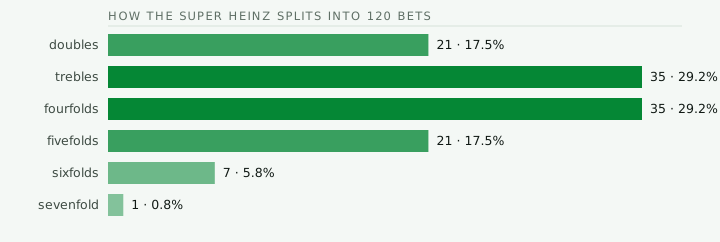
A Super Heinz is seven selections combined into 120 bets, running from 21 doubles all the way up to a single sevenfold. There are no singles, so two winners are the minimum for any return.
How a Super Heinz is made up
A Super Heinz covers every combination from doubles to the sevenfold across seven selections. That comes to 120 separate bets, so a £1 Super Heinz costs £120.00 rather than £1 — and £240.00 if you place it each way.
| Line type | Number of bets | Share of the bet |
|---|---|---|
| doubles | 21 | 17.5% |
| trebles | 35 | 29.2% |
| fourfolds | 35 | 29.2% |
| fivefolds | 21 | 17.5% |
| sixfolds | 7 | 5.8% |
| sevenfold | 1 | 0.8% |
| Total | 120 | 100% |
A worked Super Heinz example
Take seven selections between evens and 4/1, staked at £0.10 a line with every selection winning. The figures below come from the same calculation the tool above runs.
- Unit stake
- £0.10
- Total stake
- £12.00
- Returns
- £2,123.88
- Profit
- +£2,111.88
| Selection | Fractional | Decimal |
|---|---|---|
| 1 | 2/1 | 3.00 |
| 2 | 3/2 | 2.50 |
| 3 | 3/1 | 4.00 |
| 4 | 5/2 | 3.50 |
| 5 | 1/1 | 2.00 |
| 6 | 4/1 | 5.00 |
| 7 | 7/4 | 2.75 |
When a Super Heinz is the right bet
At 120 lines the Super Heinz is a serious commitment, and unit stakes are correspondingly small — 5p and 10p lines are normal, giving total stakes of £6 and £12. Working with fractional units is the only sensible way to place this bet, and the calculator is built for it.
The shape of the bet is worth understanding. Of the 120 lines, 35 are trebles and 35 are fourfolds, so the middle of the distribution is where almost all realistic returns come from. The sevenfold is a lottery ticket attached to the end; the doubles are a consolation. If you are placing a Super Heinz expecting the sixfold or sevenfold to land, the odds are unkind.
The practical case for the bet is a full card where you have seven runners you genuinely rate at reasonable prices. Four winners out of seven produces 35 winning lines across doubles, trebles and a fourfold, which is where the structure earns its keep. Four winners on an accumulator produces nothing.
Because the bet is so large, reductions matter. Each non-runner drops every line containing it by one fold, converting a Super Heinz with one withdrawal into the equivalent of a Heinz on the remaining six. Mark the void legs in the calculator rather than trying to reason it through by hand — at 120 lines the arithmetic is not something to do in your head.
There is also a practical point about unit stakes that applies from the Super Heinz upwards. Because the bet multiplies your unit by 120, small changes to the unit have large effects on the total: moving from 5p to 10p a line takes the stake from six pounds to twelve. Deciding the total you want to risk first and dividing backwards is a more reliable way to size these bets than picking a unit that sounds small and discovering what it multiplies to.
What it does well
- Very wide coverage of a seven-runner card
- Four or five winners produce substantial returns
- Reduces predictably through non-runners
What it costs you
- 120 units demands very small unit stakes
- One winner returns nothing
- The largest folds are effectively lottery tickets
Super Heinz questions
How many bets are in a Super Heinz?
One hundred and twenty: 21 doubles, 35 trebles, 35 fourfolds, 21 fivefolds, seven sixfolds and one sevenfold.
How much does a Super Heinz cost?
120 times the unit stake. At 10p a line that is £12, and at £1 a line it is £120. Each way doubles it to 240 lines.
How many winners do you need for a Super Heinz?
At least two, since the bet contains no singles. Meaningful returns generally require four or more winners, because that is where the trebles and fourfolds start settling in volume.
What is the difference between a Super Heinz and a Goliath?
A Goliath adds an eighth selection, taking the bet from 120 lines to 247. Both exclude singles; the Goliath is roughly twice the stake and twice the coverage.
What happens if a selection is withdrawn?
The void leg settles at odds of 1.00 and every line containing it drops a fold, which leaves the equivalent of a Heinz across the remaining six selections.